MHRA Device Registration: New Clarification on "Placing on the Market" and "Putting into Service" (Update 20 July 2026)
MHRA clarifies medical device registration: 20 July 2026 update explains "placing on the market" vs. "putting into service" in GB.
MedNet EC-REP
Author

On 20 July 2026, the MHRA updated its guidance on medical device registration, setting out in more explicit and practical terms than before when a medical device must actually be registered in Great Britain. For manufacturers based outside the UK and their UK Responsible Persons, this is not a minor detail: the clarification directly determines whether a device needs to be registered with the MHRA at all.
The background to the change, according to the MHRA itself: a small number of customers have registered devices that are technically classified as "put into service only" — meaning they do not necessarily fall under the registration requirement. The updated guidance is intended to remove exactly this ambiguity.
This update, and this article, concern MHRA registration for the Great Britain market only. For devices placed on the Northern Ireland or EU markets, the EUDAMED registration requirements under the EU MDR/IVDR continue to apply unchanged.
The Core Distinction: Placing on the Market vs. Putting into Service
"Placing on the market" and "putting into service" are not new concepts introduced by this update — they are terms defined in Regulation 2(1) of the UK Medical Devices Regulations 2002 (UK MDR 2002):
"placing on the market" means, in relation to a medical device, the first making available in return for payment or free of charge of a new or fully refurbished device, other than a device intended for clinical investigation, with a view to distribution, use, or both, on the Great Britain market.
"putting into service" means — (a) in relation to an active implantable medical device, the making available of the device to a registered medical practitioner for implantation; (b) in relation to any other medical device, the first making available of the device in Great Britain to a final user, including where a device is used in a professional context for the purposes of medical analysis without being marketed.
What the 20 July 2026 update adds is not a new legal definition, but a more detailed practical explanation of how the MHRA applies this existing distinction — including, for the first time in this particular guidance document, a concrete illustrative example.
In most cases, a device is first placed on the market and is subsequently put into service once it reaches the end user. The MHRA's own worked example for the "putting into service only" scenario is a hospital that makes and uses its own medical devices on site, without any marketing or distribution involved. It is worth noting that this example is broader than the statutory wording itself: Regulation 2(1)(b) specifically refers to a device "used in a professional context for the purposes of medical analysis" — manufacturers should not assume the exception automatically extends to every form of in-house use beyond that context.
A practical point worth flagging explicitly: the "placing on the market" definition applies "in return for payment or free of charge" alike. This means a device supplied at no cost — for example a demonstration or evaluation unit sent to a UK hospital or distributor — is capable of being "placed on the market" in its own right, regardless of the absence of payment. Free-of-charge supply does not, by itself, make a device "put into service only"; that status depends on whether the device is distributed/marketed at all, not on whether money changes hands.
When Registration Is "Encouraged" but Not "Required"
From this distinction, the MHRA derives a clear rule of action: if a device is both put into service and placed on the market, it must be registered with the MHRA. If a device is put into service only — without ever being placed on the market — MHRA registration is encouraged but not required (Source: Putting into service).
The MHRA points to its own, more detailed guidance on placing on the market and putting into service for further reading.
Further Clarifications in the Same Update
Alongside the core distinction, a new section on discontinuation of devices was added: if a device is permanently withdrawn from the market and no further units are placed on the market, the MHRA registration requirement no longer applies from that point onward. Post-market surveillance and vigilance obligations for devices already on the market remain unaffected.
The update also confirms a fee deadline extension that had already been announced on 26 June 2026: the payment deadline for the new Annual Fee has been extended by one month, to 31 July 2026, to give customers additional time to adjust to the new fee structure. Accounts that have not yet paid the Annual Fee will remain active during this extended period (Source: Fees).
Conclusion
The 20 July 2026 update does not change the underlying legal definitions in the UK MDR 2002, but it does provide, for the first time in this guidance document, a substantive and example-based explanation of the distinction between "placing on the market" and "putting into service" — bringing greater regulatory clarity for anyone registering devices in Great Britain. Manufacturers and UK Responsible Persons currently maintaining device registrations with the MHRA should take this opportunity to review their own registration practices in light of this clarification.
Not sure whether your devices are correctly registered?
As your UK Responsible Person, we review your DORS account and ensure your registration meets current MHRA requirements.
Related Articles

IVDR Rule 7: When Is IVD Control Material Class B? (MDCG 2020-16 Rev. 5)
MDCG 2020-16 Rev. 5 clarifies when IVD control material without an assigned value falls under class B, and when another rule applies.
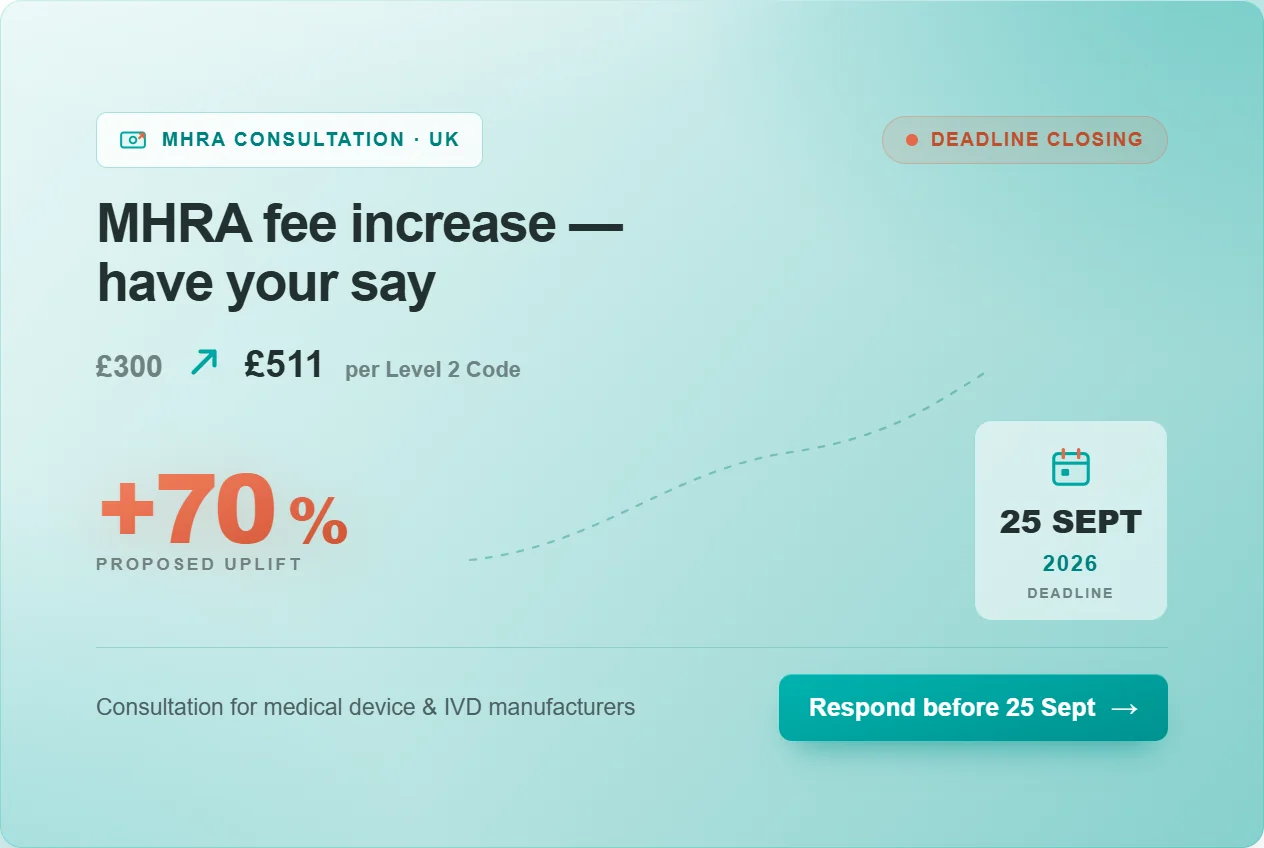
MHRA Consultation 2026: The Fee Increases Coming for Medical Device Manufacturers in 2027
The MHRA has opened a consultation on fee increases from April 2027 — including a proposed 70 % rise in the post-market surveillance fee. Manufacturers have until 25 September to respond.

New EU Study: Where Manufacturers and Authorised Representatives Really Stand on MDR and IVDR
New EU study finds 48% of manufacturers have withdrawn devices from the market. Key MDR/IVDR and AR findings for 2026. Read the numbers now.
Stay Updated
Get the latest regulatory updates and industry insights delivered to your inbox.
Subscribe to Updates